
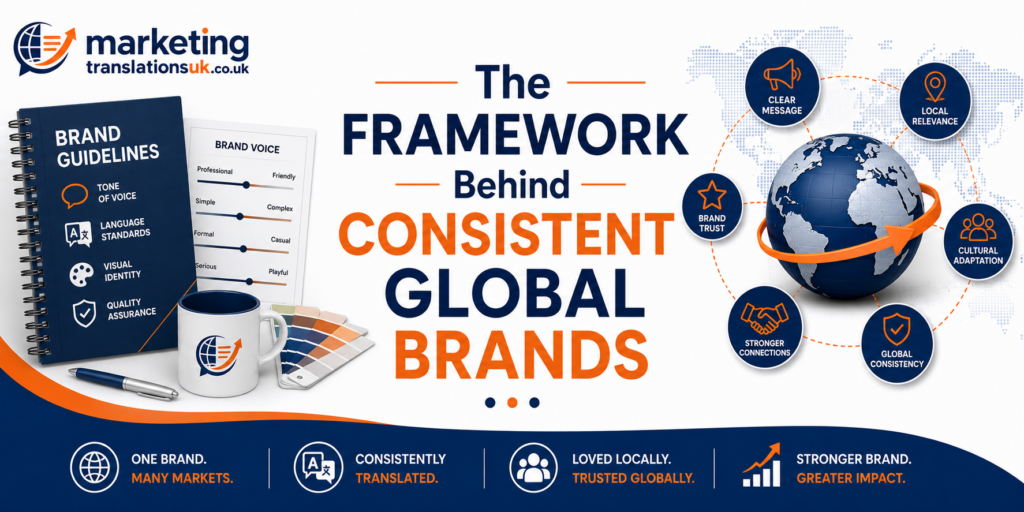
Website localisation governance is the framework — an ownership model, a shared glossary, and a named reviewer per market — that keeps a multilingual site consistent as it scales past two or three locales. Without it, terminology drifts, regional offices rewrite approved copy, and every product release breaks live translations. The fix is not more translation; it is deciding who owns copy, building shared linguistic assets, and naming one reviewer per market before you add another locale.
Most projects we are brought into are already half broken, and the translation is rarely the reason. At Marketing Translations UK, we see the same pattern constantly: content was translated first and organised afterwards, so terminology has drifted, regional offices have started rewriting approved pages, every product release ships English strings into live locales, and nobody can say who signs off quality in Portuguese. Each individual fix is small. Together they cost more every quarter than building the framework would have cost once.
This is about who owns what. The technical build — hreflang, slugs, sitemaps, URL structure — is a separate discipline entirely, and worth getting right before governance even becomes the bottleneck.
Four Signs Your Website Localisation Governance Is Missing
You can diagnose this without an audit.
Terminology has drifted. Your product is called three different things across the German site, the German ads and the German product feed. Nobody decided this; three people each made a reasonable choice.
Regional offices have gone rogue. Local marketers rewrite approved copy because it does not sound right to them, and nobody records the change. Six months later the source of truth is gone.
Releases break translations. Every website update ships untranslated strings into live locales, and the fix happens after a customer reports it.
Nobody owns quality. Translation is checked by whoever in the business happens to speak the language, rather than by a qualified reviewer with a defined remit.
If more than one of these is familiar, adding a sixteenth locale will multiply the problem rather than dilute it. Fix the framework before you scale the content.
Prioritise Markets Before You Translate A Page
Localise where demand already exists, not where the ambition is. Your own analytics usually name your first two markets more accurately than a strategy deck does.
Look at organic sessions by country, assisted conversions, support enquiries arriving in other languages, and where competitors are already advertising. Then rank markets into tiers and treat each tier differently rather than pretending all markets get the same service.
Tier 1 markets get the full treatment: rebuilt hero pages, localised campaigns, local legal pages, native review before publication. Tier 2 markets get core pages properly translated and long-tail content handled more lightly. Tier 3 markets get an English site with clear local shipping, pricing and contact details until they earn more investment.
Two locales done completely beats six done partially. Half-finished locales get indexed, rank poorly, and damage brand perception in precisely the markets you were trying to impress.
Build The Linguistic Assets Before The First Page Is Translated
A glossary and a translation memory are what keep fifty pages sounding like one company. Build them once and every future project gets faster, cheaper and more consistent.
Glossary, Translation Memory And A Do-Not-Translate List
Your glossary fixes approved terminology per language: product names, feature names, industry terms, and the words you never want rendered literally. It is the single asset that prevents the terminology drift described above.
Your translation memory stores approved sentences so repeated content is reused rather than re-bought. On any site with a catalogue, this is where the long-term savings actually come from, and the effect compounds with every batch.
Your do-not-translate list protects trademarks, product names and any campaign line that must remain in English in every market. Without it, someone will eventually translate your tagline, and you will find out from a customer.
Who Holds Them
These assets need an owner inside your business, not just inside your supplier. If the glossary lives only with the agency, you lose it when you change supplier, and the next one starts from a blank page at your expense. This is exactly the kind of contract term worth settling upfront — covered in more depth in how to vet a marketing translation supplier.
Ask for the glossary and translation memory to be delivered to you in a portable format at agreed intervals. This is a normal request and a reasonable supplier will not resist it.
Website Localisation Governance: Choose A Model And Name The Reviewers
Decide who owns copy before you scale, or your locales will drift regardless of how good the translation is. Most global brands land on one of three models.
| Model | How it works | Best for | Watch out for |
|---|---|---|---|
| Centralised | HQ controls all messaging; markets receive finished copy | A strong single brand identity, regulated sectors | Local teams feel ignored and quietly rewrite pages anyway |
| Regional autonomy | Each market writes its own content | Genuinely different products or buyer behaviour per market | Brand consistency and search signals fragment fast |
| Hybrid | HQ owns brand messaging and structure; in-country reviewers approve tone and local detail | Most global brands running five to fifteen locales | Needs a named reviewer per market, or approvals stall indefinitely |
The hybrid model works for most brands, with one condition: one named in-country reviewer per market, with real authority to approve. Not a committee, not a rota, not whoever is free.
This removes the largest single cause of rework, which is local teams changing copy after publication because they were never consulted before it. Rework almost always comes from exclusion rather than from poor translation.
Give that reviewer a narrow, written remit: they approve tone, register and local detail. They do not reopen brand messaging or page structure. Where the brand’s voice itself needs defining across languages, that is a separate document and a separate exercise — set out in how to hold one brand voice across languages in every market.
Design Constraints Nobody Retrofits Cheaply
Layout problems are inexpensive to prevent and expensive to fix after launch. Decide these before your first locale goes live.
- Text expansion. German and French commonly run 20–35% longer than English. Buttons, navigation and hero headlines break first, and they break in the places customers look.
- Right-to-left support. Arabic and Hebrew need mirrored layouts, not translated strings dropped into a left-to-right template — W3C’s internationalisation guidelines are the standard reference for getting this right.
- Fonts and character support. Confirm your typeface handles accents, Cyrillic, Arabic and CJK before design sign-off, not after.
- Formats. Dates, numbers, currency, addresses, phone fields and name fields all differ. A form that rejects a valid local postcode loses the lead instantly and silently.
- Imagery. Photos, icons and gestures carry cultural meaning that does not travel. Review them per market rather than assuming they are neutral.
Build Quality Control In, And Measure By Locale
Quality control is a process, not a final glance before publishing.
The shape that works: a qualified translator produces the copy, a second linguist reviews tone and terminology independently, and the in-country reviewer checks it in context on a staging page. That last stage matters more than it sounds. Reviewing text inside a spreadsheet hides most real errors, because a headline that fits comfortably in a cell can still break the layout and lose its meaning on a live page.
Machine output alone should never reach a hero page, a campaign line, or any legal or safety text. The grammar survives that route; the persuasion does not.
To prove the value internally, report by locale, never as a total. An aggregate number hides both your best market and your worst.
- Conversion rate and lead quality per locale
- Organic visibility and indexed pages per language
- Bounce rate and scroll depth on translated pages
- Support enquiries caused by unclear content
- Time to market for each new locale
That last metric is the one that improves fastest once the framework exists, and it is the easiest to defend a budget with.
Frequently Asked Questions
How Many Languages Should A Global Brand Launch With?
Start with two, done completely. Depth outperforms breadth, because search engines and buyers both reward finished experiences. Once the process, glossary and review workflow are proven in two markets, the third and fourth become considerably faster and cheaper.
What Should Be Localised First On A Website?
Homepage, top landing pages, navigation, forms, pricing, contact and legal pages, because they carry the journey. Blog archives and long-tail content can follow. Anything a buyer reads before deciding, or before deciding to trust you, belongs in phase one.
How Do We Stop Regional Offices Rewriting Approved Copy?
Involve them before publication rather than after. Give each market one named reviewer who signs off tone and local detail during the review stage, and give that sign-off real weight. Teams rewrite copy when they were excluded from producing it.
Who Should Own The Glossary — Us Or Our Supplier?
You should, with the supplier maintaining it on your behalf. Ask for periodic delivery in a portable format. A glossary that lives only inside an agency becomes a switching cost rather than an asset.
How Long Does Website Localisation Take For A Global Brand?
A well-prepared first locale typically takes four to eight weeks including preparation, translation, review and technical checks. Later locales move faster because the assets and workflow already exist. Rushed launches without that groundwork usually lose more time in corrections than they saved.
We Already Have Fifteen Locales And No Framework. Where Do We Start?
Start with the glossary and the reviewer list, not with retranslation. Fixing terminology and naming owners stops the drift from getting worse immediately, and costs a fraction of rebuilding content. Retranslate afterwards, market by market, prioritised by revenue.
Before Your Next Locale Goes Live
Localisation rewards brands that prepare and punishes the ones that translate first and organise later. The companies that get this right are not the ones with the biggest budgets — they are the ones with a glossary, an ownership model, a named reviewer per market, and a review stage nobody is permitted to skip.
We have built exactly this framework for brands moving from two locales to fifteen, and the pattern repeats every time: the fix is never a better translator, it is a process someone finally owns. We handle the linguistic assets, the translation, the second review and the in-context checks, so your internal teams can work on the campaign rather than chase corrections. Our specialists work only on marketing and ecommerce content, and every project goes through a named reviewer before it reaches you, not after.
Whether you are preparing a first market or repairing a rollout that grew faster than its process, tell us where you are and we will give you a straight assessment of what to fix first. Send us your site and target markets.