
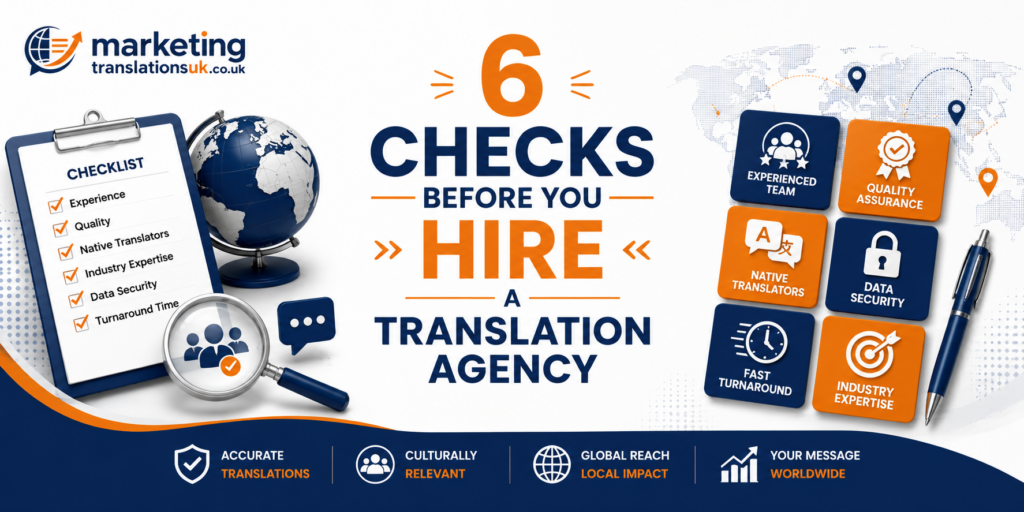
Every marketing translation supplier says they are experienced, native and thorough. None of that is checkable. So most shortlists get decided on price and turnaround instead — the two things easiest to compare, and least likely to predict the outcome.
Vetting a marketing translation supplier properly takes about twenty minutes of questions. The point is not to catch anyone out. It is to work out whether the person who eventually writes your German headline has ever written marketing copy in German, or whether they spent last week on a supply contract.
At Marketing Translation UK, this is the assessment we ask every prospective client to run on us too — so we know exactly which questions actually separate a real specialist from a reseller. This guide covers both sides of the decision: the six capability checks to run before you shortlist a supplier, and the contract terms worth settling once you are ready to sign.
Check 1: Is Marketing Their Specialism Or One Of Twenty Services?
Most translation companies handle contracts, manuals, patents and medical records alongside advertising, and process all of it the same way — translate accurately, proofread, deliver. That process is right for a contract and wrong for a headline.
Marketing copy is not judged on accuracy. It is judged on whether it makes someone act. A supplier built around marketing arranges its workflow differently. It briefs on audience and tone, not just terminology. It expects to produce options rather than one version. And it treats a five-word line as a bigger job than a five-hundred-word page.
What to ask: what proportion of your work is marketing content? Not “do you offer marketing translation” — everyone offers it. Ask for a share. A supplier who does it daily will answer instantly and describe a different process for it. A supplier who does it occasionally will describe the same process they use for everything else.
Check 2: Who Actually Writes Your Copy?
This is the question that separates suppliers who do the work from suppliers who resell it.
Some quotes come from an agency that will pass the job to another agency, which finds a freelancer. Every layer takes a margin, so the person writing your headline may be receiving a fraction of what you pay and working at whatever speed that rate allows. Nothing about the quote tells you this.
What to ask: who will write this, where do they live, and what is their background? A confident supplier answers with a market, a specialism and a rough profile. “A native French speaker” is not an answer. “A native French speaker based in Lyon who works on consumer campaigns weekly” is.
Location matters more for marketing than for any other content type, because marketing borrows constantly from what is current — slang, humour, the way people actually talk this year. A translator who left the country a decade ago will produce correct copy that sounds subtly dated, and neither of you will be able to say why.
Check 3: Do They Match Translators To Your Sector?
Language skill and marketing skill are separate. Sector knowledge is a third thing again.
A translator who works mostly on technical documentation can render every word of your fashion campaign correctly and still produce a line that lands flat. Writing to persuade is a different job from writing to inform. Cosmetics, supplements, finance and healthcare add a further layer, since each has terminology that is regulated and phrasing that is not permitted.
What to ask: are translators matched to my sector, and can you show me something comparable? A supplier who assigns by language alone will say every translator is experienced. A supplier who assigns by language and sector will ask what you sell before quoting.
Check 4: What Happens Between First Draft And Delivery?
A reliable supplier never sends a single translator’s first draft as the finished product. Ask how a piece of copy travels from first version to the file that lands in your inbox.
You are listening for a named second person — a reviewer who checks tone, terminology and consistency independently. “We proofread everything” describes the same translator rereading their own work, which catches typos and nothing else. “Internal QA” usually means a project manager who does not speak the language checking that the file is complete.
The strongest answer includes a third stage: someone reviewing the copy in context, on a staging page or in the layout, rather than in a spreadsheet. A headline that fits comfortably in a cell can still break a button and lose its meaning on a live page.
Check 5: Where Do They Stand On Automated Tools?
You are entitled to a direct answer, and how a supplier handles the question tells you as much as the answer itself.
Ask plainly whether any stage involves machine output with human editing. There is nothing wrong with that approach in the right place — it is a sensible route for long-tail product pages and help content. It is the wrong route for a tagline. What you need to know is where the line sits and whether the supplier will tell you where it sits.
Evasion is the signal. Watch for a supplier who redirects the question, answers about a different stage, or talks about “AI-assisted workflows” without saying what is assisted. That answer tells you what you need to know.
There is also a practical test. Send a short passage containing an idiom and a pun as part of your assessment. Machine-assisted output keeps the English sentence shape and turns the wordplay into plain description. Genuine creative work changes the structure entirely and reads as though it was written in that language first — the underlying reasons why are set out in why machine translation fails for marketing campaigns in Europe.
Check 6: Do They Cover What You Will Need In A Year?
A supplier who is excellent in three languages and weak in the fourth becomes a problem the month you enter a fourth market. The same applies to formats.
Marketing content is not only website copy. Over a year most brands need ad campaigns, email sequences, social captions, product listings, subtitles, voiceover scripts and print material. A supplier who only handles web text will leave gaps as your campaigns get more varied. You then end up managing two vendors and two versions of your terminology.
What to ask: confirm the full language list and the full format list now, including languages you are not using yet. It costs nothing to ask and saves an awkward handover later.
Marketing Translation Supplier Red Flags Worth Taking Seriously
None of these is fatal on its own. Two or three together usually mean you are talking to a reseller rather than a producer.
- No willingness to describe who will write the copy, or where they are based
- Marketing listed as one line among fifteen document types, with no separate process
- “We proofread everything” offered as the entire quality answer
- No relevant samples, and case studies with no named market, brief or outcome
- Deflection when you ask directly about machine output
- Turnaround promises that are noticeably faster than everyone else’s, with no explanation of how
A Fifteen-Minute Assessment Any Marketing Translation Supplier Should Pass
You do not need a formal RFP for this.
- Send the same short brief to your shortlist. One genuinely difficult asset — a headline with wordplay, or a call to action with a character limit. Product descriptions tell you nothing, because everyone handles them adequately.
- Pay for it. Free samples get written by whoever is free that day, not by the person who would be assigned to your account. They test a different service from the one you would buy.
- Judge the response, not just the copy. Did they ask who the audience is? Did they flag a problem in your English source? A supplier who spots that your original line will not work in three of your markets has already earned the fee.
- Ask for the reasoning. Any supplier doing genuine creative work can explain why they chose one route over another. That explanation is the most reliable evidence of real human work, because no automated process produces it.
Settle These Terms Before Any Work Starts
Capability gets you a shortlist. These four terms decide what you actually end up owning, and all of them are cheap to fix before signing and expensive to discover afterwards.
Get The Quote Itemised
Quotes for an identical brief routinely differ by several thousand pounds. It is almost always a scope difference rather than a pricing one.
Ask every supplier to break the number down against the same list. How many creative routes per line. Whether a named second linguist reviews the work. Whether anyone in the target country sees it. How many revision rounds are included, and what counts as a revision.
Then reissue one defined scope and ask for a requote. The numbers usually converge sharply. Any supplier who returns a single total with no breakdown has told you something useful.
Get Copyright Assigned In Writing
In the UK, rights in commissioned creative work do not automatically transfer to whoever pays for it unless the agreement says so. Ask for assignment effective on payment, covering all markets and all media.
This becomes a live problem the first time you want to reuse an approved line. A different market, a different medium, or a campaign three years later that the original supplier has nothing to do with.
Sign The Nda Before You Send Anything
Campaign material is commercially sensitive before launch. Ask where linguists are based and where files are processed. If personal data appears anywhere in your files, add a data processing agreement too, because UK GDPR obligations follow the file wherever the writer sits.
Put The Service Level In The Contract, Not In Email
Delivery dates, response times, a named escalation contact, and what happens if a deadline is missed during launch week. On a fixed campaign date this clause matters more than the rate does. It is also the one nobody negotiates until the week they need it.
One warning sign worth naming: unlimited revisions offered casually is not a benefit. It generally means the first draft is not expected to be close, and that the editing will be yours.
Frequently Asked Questions
Should I Use A Uk-Based Supplier Or One Based In My Target Market?
A UK-based supplier generally means overlapping working hours, easier escalation and familiarity with UK marketing conventions, while still using translators who live in your target markets. What matters is where the translator sits, not where the invoice comes from.
Is Certification Proof Of Quality For Marketing Work?
It is evidence of process discipline rather than creative capability. Standards such as ISO 17100 describe translation workflows — qualifications, resources, project management — not persuasive writing. Treat certification as one signal alongside specialism, named linguists and a paid test, not as proof on its own.
How Many Suppliers Should I Shortlist?
Two or three. More than that and you spend longer running the assessment than the first project is worth, and the differences between the fourth and fifth candidate are rarely meaningful.
Do I Need A Different Supplier For Each Language?
Usually not. One supplier across all markets keeps terminology stable and gives you a single point of accountability. Splitting suppliers makes sense only where one market is genuinely specialist, and you then take on the job of keeping the brand aligned yourself.
What If I Have Already Hired Badly And The Copy Is Live?
Prioritise by visibility rather than volume. Rebuild the pages that carry your positioning and your revenue first, measure for a month or two, then work outwards. Retranslating everything at once is rarely the right call.
Before You Send Your Brief Out
The suppliers worth working with are the ones who answer these questions specifically rather than reassuringly. Vagueness at the vetting stage almost always becomes vagueness in the work.
If you want a straight comparison, send us the same brief you are sending everyone else. Our translators work only on marketing content. We will tell you which parts of your source will travel well, which need rebuilding, and who would be assigned to the job. Send your brief through here with your target markets and deadline.