
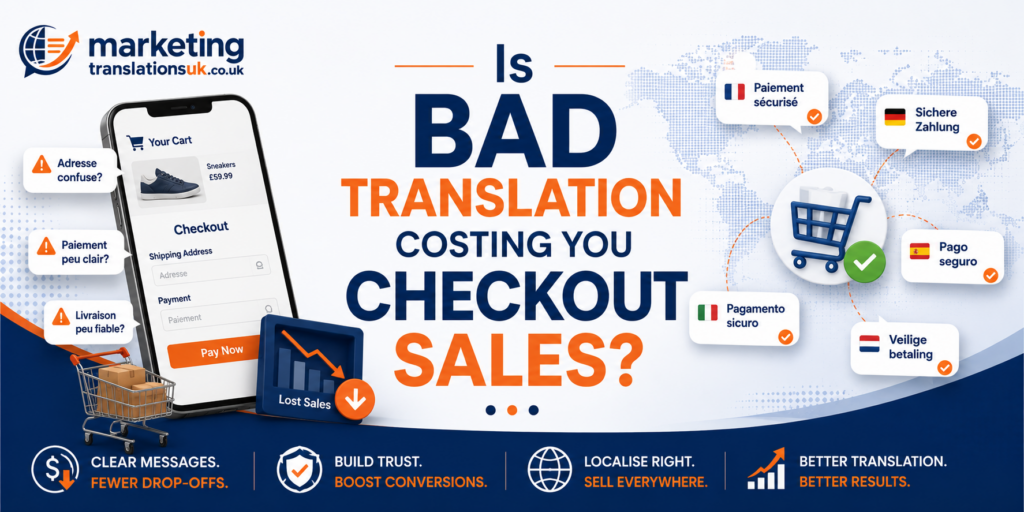
Yes — automated product description translation is one of the most common hidden causes of low checkout conversion in international markets. Machine output is usually grammatically correct but commercially weak: it flattens persuasive copy, mistranslates materials and sizing, and leaves buyers unsure enough to abandon the cart. The fix is not translating your whole catalogue by hand; it is identifying the pages that carry your revenue and rebuilding those with human translators.
Over the years, we have audited a lot of storefronts where the traffic graph looked fine and the revenue graph did not. In almost every case, the store owner assumed the problem was pricing, shipping or the checkout flow — and in almost every case, the product pages were doing the damage first. At Marketing Translations UK, our specialists translate marketing and ecommerce content only, so we read these pages the way your buyer does. Here is how to confirm whether your translated descriptions are the culprit, and what to fix without blowing the budget.
Diagnose It From Your Own Analytics First
Your data already holds the answer. You just need to segment it by language rather than by country, because a German-speaking visitor on an English page behaves nothing like one on a German page.
Pull these five numbers before you change anything.
Conversion rate by landing language. Compare like with like. If the German-language segment converts at a third of the English one on comparable traffic, the pages are the variable, not the audience.
Add-to-cart rate per market. This is the sharpest single signal. A drop before add-to-cart means the description failed to convince. A drop after it means checkout, shipping or duties are the problem, and you are looking in the wrong place. Cart abandonment runs high across ecommerce generally — Baymard Institute’s research puts the global average above 70% — so isolating whether your rate is a translation problem or a universal checkout problem matters before you spend on either.
Time on page and scroll depth. Very short sessions on translated product pages usually mean the copy read as machine-generated within the first two lines. Buyers make that judgement fast and rarely scroll to give you a second chance.
On-site search terms in each language. If shoppers are repeatedly searching for a word that appears nowhere in your translated catalogue, your terminology is wrong — you are using the dictionary term and they are using the market term.
Return reasons by market. “Not as described”, “wrong size” and “different from the picture” clustering in one country is a translation problem wearing a logistics costume.
One refinement worth adding: segment by landing language and device. Mobile product pages show fewer lines above the fold, so a weak opening line costs you twice as much there.
The Product Page Details Machines Reliably Get Wrong
Automated output handles general prose acceptably and product specifics badly. The errors cluster in exactly the fields a buyer checks before paying.
Materials, ingredients and care instructions. Compound descriptions like “cotton-lined” or “leather-look” come out vague or plainly wrong. A shopper who cannot confirm what a product is made from does not gamble.
Sizing, fit and units. UK 6 is not EU 40. Inches are not centimetres. An unconverted size guide is the fastest route to a return, and returns quietly destroy your margin in Europe — this is one of the sharpest differences between markets, covered in more depth in selling online in France and Germany.
Thresholds and offers. A delivery threshold converted at the day’s exchange rate arrives as an odd, precise number that no local retailer would ever display. It signals immediately that the store was built for a different country.
Idioms and false friends. Marketing English is full of phrases that convert into something odd, over-formal or accidentally comic. This costs more on a product page than anywhere else, because the buyer is holding their card at that moment.
Specification tables and attribute labels. Feeds and PIM exports frequently push half-translated labels. Mixed English and German inside one spec table reads as broken rather than multilingual, and it is often the last thing anyone checks.
Review content and user-generated text. Social proof only works in a language the buyer reads comfortably. English reviews under German copy tell the shopper that nobody local has bought this.
Why Weak Copy Hits Checkout, Not Just Search
Checkout abandonment is usually a trust decision, and trust is built on the product page. By the time someone reaches the payment step, they have already decided whether this store feels legitimate.
Three things happen when descriptions read as machine output.
Doubt replaces desire. The shopper cannot confirm the product matches their need, so they save it for later and never return. This shows up as a healthy add-to-cart rate and a terrible completion rate.
The brand feels foreign. Buyers reason, not unreasonably, that a store which cannot write their language properly will not handle their returns properly either.
Support load rises. Pre-purchase questions that the description should have answered land in your inbox instead — and most shoppers never bother asking. For every question you receive, several people simply left.
Stores that fix only their top-selling product pages usually see the clearest movement in checkout completion, because those pages carry most of the revenue anyway.
You Do Not Need To Translate Five Thousand Skus
Full human translation of a large catalogue is rarely necessary and rarely affordable. Sorting the catalogue by revenue gets you most of the gain for a fraction of the cost.
| Tier | What goes in it | Treatment | Why |
|---|---|---|---|
| Tier A | Bestsellers, hero products, top collections, homepage, checkout and returns copy | Full human translation, rebuilt rather than converted | These pages carry the majority of revenue; tone and persuasion matter most here |
| Tier B | Mid-performing products, seasonal ranges, category descriptions | Machine output with a native editor | Fast and affordable, with a human fixing accuracy, terminology and tone |
| Tier C | Long tail, discontinued lines, low-traffic SKUs | Raw machine output, revisited later | Acceptable risk while volume is negligible — upgrade a SKU the moment it starts selling |
Two things make this work. First, build a glossary and translation memory before any tier is translated, so your product terminology stays identical across the catalogue, your feeds and your marketplace listings. That consistency is what stops the same jacket being described three different ways on your store, in Google Shopping and on a marketplace.
Second, treat the tiers as movable. A Tier C product that starts selling should be promoted, not left as it was because of a decision made a year ago.
An Audit You Can Run This Week
You can diagnose this yourself in a few hours. The goal is evidence, not a rewrite.
- Pick your top 20 products in one underperforming market. Revenue-ranked, not alphabetical.
- Have a native speaker read them as a buyer. A colleague, a customer, a supplier. Ask them to mark anything that reads oddly, not to check for errors — those are different tasks and only the first one finds what you are looking for.
- Check the fields nobody checks. Titles, meta descriptions, slugs, size guides, attribute labels, delivery text and returns wording. The worst errors hide outside the description body.
- Compare your product titles with in-market search terms. Converting your English keyword rarely matches how local shoppers actually search.
- Score each page as fine, weak or broken. Most audits find a handful broken and a great many weak. The weak ones are where the money is.
- Fix Tier A first, then measure for 30–60 days. Change one variable so you can prove what worked.
If your store also has technical gaps — broken hreflang, English slugs, missing metadata — fix those alongside the copy, since neither works properly without the other. The setup checklist for Shopify stores is in how to localise your UK Shopify store for European markets.
Frequently Asked Questions
Does Automated Translation Always Hurt Conversions?
No. It works acceptably on low-value, low-traffic pages and internal content. It hurts most on revenue pages, where tone, accuracy and persuasion decide the sale. Machine output for the long tail and human work for the products your buyers see first is the sensible split.
Is Edited Machine Output Good Enough For Product Pages?
For mid-tier products, yes. A native editor fixes accuracy, terminology and awkward phrasing at a lower cost than full translation. For hero products and campaign copy it is not enough, because the original idea usually needs rebuilding rather than correcting.
How Quickly Do Improvements Show Up After Fixing Descriptions?
Conversion changes often appear within a few weeks, since returning and paid traffic hit the fixed pages immediately. Organic improvements take longer — typically one to three months — because search engines need to recrawl and reassess the updated titles, metadata and slugs.
How Many Products Should I Translate Properly To Start?
Usually between twenty and fifty per market. In most catalogues that group accounts for the large majority of revenue, and it is small enough to fund without a business case.
Should Marketplace Listings Be Translated Separately From My Store?
They should match. Listings drawing on a different translation from your own store creates inconsistent product names and confused buyers who assume they are looking at different items. One shared glossary should feed every channel.
My Descriptions Are Supplier-Provided. Does That Change Anything?
It makes the glossary more important, not less. Supplier copy tends to arrive in inconsistent English before anyone translates it, so the same product attribute appears three ways in the source. Fix that first, or you will pay to translate the inconsistency.
Turn Your Product Pages Back Into Sellers
Automated translation is not the enemy — using it on the pages that carry your revenue is. Every store we audit has a small group of products doing most of the work, and those are exactly the pages where a machine-written description quietly costs you the sale. Our specialists rebuild that copy so it reads like it was written for that market, keeps your brand voice intact, and gives the buyer every detail they need before they reach the payment step.
We work only on marketing and ecommerce content, so your product pages stay persuasive rather than merely accurate, and our editors check terminology across the whole catalogue for consistency. Send us a sample of your translated product pages and tell us which market is underperforming. Get a free review here — there is no obligation attached.