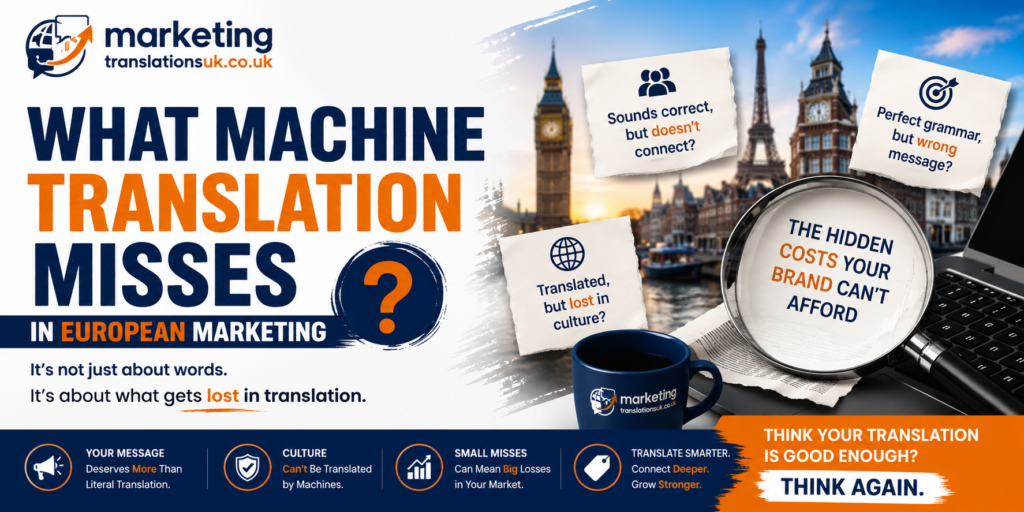
Machine translation fails for marketing campaigns in Europe because it converts words, not intent. It cannot judge tone, rebuild wordplay, or adjust a message for the cultural expectations of a specific country, which is why grammatically correct copy still falls flat with the audience it’s meant to persuade.
A few years ago, a client came to us at Marketing Translation UK after launching a product page across three European markets using machine translation. The words were correct. The grammar was clean. But engagement dropped by half in one market, and the campaign was quietly pulled within two weeks. Nothing was “wrong” with the translation — yet it didn’t work.
We see this more often than most marketing teams expect. Marketing isn’t about words. It’s about intent, tone, and timing — and that’s exactly what gets lost in machine translation. In 15 years of translating campaigns across European markets, we’ve watched the same failure patterns repeat, market after market.
Here’s what we’ve found actually causes it, and what we tell every client to check before their next launch.
Why Europe Is the Hardest Market for Machine Translation to Get Right
Europe is not one market. It’s over 40 countries and more than 24 official languages, and several of those languages are shared across countries with very different cultures.
German is spoken in Germany, Austria, and Switzerland — but tone expectations differ in each. French in France is not the same as French in Belgium. Even within one country, formality changes by audience: a campaign aimed at professionals in the Netherlands needs a different register than one aimed at younger consumers.
Machine translation systems are trained to produce one “correct” version of a language. They don’t ask which country, which age group, or which tone a brand is going for. A phrase that sounds confident in one European market can sound cold, overly formal, or even rude in a neighbouring one — despite using the same language.
This is why a campaign that performs well in Spain can underperform in Mexico, or why German copy that works in Berlin can feel off in Zurich. We account for this before a single word is chosen. Machine translation cannot.
There’s also the question of how people actually search and shop in each country. A phrase that ranks well in France may not match how the same product is searched for in Belgium, even in French. Machine translation treats language as fixed rules, when in reality, every market has its own vocabulary, its own preferred phrasing, and its own buying habits.
Reasons Machine Translation Fails in Marketing Campaigns
Marketing copy is designed to do one thing: evoke an emotion that drives an action. It relies on wit, rhythm, and cultural context. Machine translation (MT) engines fail here because they are programmed for literal decoding, not emotional persuasion.
Here is exactly where the technology breaks down:
- Idioms and wordplay — Slogans often rely on rhyme, double meaning, or wordplay that only works in the original language. Translated literally, the phrase loses its punch or makes no sense at all.
- Tone and formality — Many European languages have formal and informal address (like “Sie” vs “du” in German, or “vous” vs “tu” in French). Machine translation often defaults to one form regardless of the brand’s actual tone, making a friendly brand sound stiff, or a premium brand sound too casual.
- Call-to-action phrasing — Lines like “Grab yours now” or “Don’t miss out” carry urgency in English. Translated directly, they can come across as pushy or even aggressive in cultures where indirect phrasing is the norm.
- Cultural references — Campaigns that reference local habits, seasons, or events don’t translate at all — they need to be replaced with something relevant to the new market, something machine translation has no way of identifying.
- Humor — Humor depends heavily on cultural context and timing. What reads as witty in one language often reads as confusing or flat once translated word-for-word.
- Sentence rhythm — Marketing copy uses short, punchy sentences meant to be scanned quickly. Machine translation often expands these into longer, grammatically correct sentences that feel slower to read.
Each of these is a small gap on its own. In a full campaign — headline, ad copy, email, landing page — these gaps add up fast.
Real Examples: When Machine Translation Backfired in Europe
These aren’t rare, hypothetical risks. Several well-known brands have faced this exact problem when translation was rushed or handled without proper human review.
| Brand | Market | What Went Wrong | Result |
|---|---|---|---|
| HSBC | Multiple European markets | Its global tagline was understood as the opposite of its intended meaning | $10 million global rebrand |
| Mercedes-Benz | Germany-origin campaign | An English slogan translated into German lost its emotional tone and read as flat | Campaign had to be reworked with local input |
| A major fast-food chain | Spanish-speaking market | A direct translation of an English phrase came across as a command rather than an invitation | Copy was rewritten by local marketers |
| Amazon | Sweden | Product listings launched using machine translation without human review | Public criticism over broken and unnatural phrasing |
None of these were caused by bad translators. They happened because speed was prioritized over review, and machine output was trusted without a native marketing check.
How a Failed Translation Can Cost Your Business More Than Money
The most visible cost of a bad translation is embarrassment. The real costs are quieter, and they hit the business long after the launch:
- Lost search visibility — Machine-translated keywords rarely match what people actually search for in that country. The result is a page that’s grammatically correct but invisible in local search results.
- Compliance risk — Advertising rules differ by country. A claim that’s legally fine in the UK can be considered misleading in Germany or France. Machine translation has no awareness of local advertising law.
- Silent customer loss — Most people who find a translation “off” don’t complain. They simply leave the page and go to a competitor. This shows up as a slow drop in conversion, not a single visible failure.
These costs rarely show up in a single report. In our experience, they surface over months, as traffic, trust, and conversions quietly decline.
What Makes a Marketing Campaign Successful? A Quick Checklist
Before launching in a new European market, we ask every client to run their campaign against these points:
- Has a native speaker from the target country reviewed the final copy, not just checked the grammar?
- Does the tone match how your brand actually sounds — friendly, formal, playful — in the original language?
- Have slogans or wordplay been rebuilt for the local language, rather than translated directly?
- Have local keywords been researched separately, instead of translating your existing keyword list?
- Has the call-to-action been checked for tone, so it invites rather than commands?
If any answer is no, the campaign carries risk that machine translation alone won’t catch.
Machine Translation vs. Human Transcreation — What Actually Changes
Translation converts words from one language to another. Transcreation rebuilds the message so it carries the same intent, tone, and impact in the new language — even if the exact words change completely. This is the approach we use for every marketing project we take on.
| Comparison | Machine Translation | Human Transcreation |
|---|---|---|
| Focus | Word-for-word accuracy | Intent, tone, and impact |
| Handles idioms/wordplay | No | Yes, rebuilt for the local language |
| Adjusts tone by audience | No | Yes |
| Understands local advertising norms | No | Yes |
| Best suited for | Internal documents, basic information | Slogans, ads, campaigns, brand messaging |
This is why we work only on marketing content, with translators who specialise in it, rather than treating it as one of many document types.
The Real Cost Comparison — Fixing a Mistake vs. Doing It Right the First Time
Our professional marketing translation typically costs between €0.12 and €0.22 per word, depending on how creative the content is. A landing page of 500 words, translated professionally, costs a small fraction of most marketing budgets.
Compare that to the cost of fixing a failed campaign: rewriting copy, redesigning assets, relaunching in-market, and in some cases, a full rebrand — as seen in cases like HSBC’s $10 million correction. The upfront cost of proper translation is minor compared to the cost of undoing a mistake after launch, in both money and lost market trust.
There’s also a time cost: a failed launch means weeks of delay for rewriting, re-approval, and relaunch, on top of the money already spent.
Frequently Asked Questions
Can machine translation be used at all in marketing?
Yes, for early drafts or internal review. We don’t recommend using it as final, published campaign copy without a human marketing translator reviewing and adjusting it.
Is human translation necessary for every European language?
For marketing content, yes. Even closely related languages and dialects carry different tone expectations that automated tools cannot judge.
How much does professional marketing translation cost compared to machine translation?
Machine translation is free or low-cost upfront, but carries the risk of costly corrections later. Our professional marketing translation starts around €0.12 per word and protects the campaign before it launches, not after.
Does using tools like Google Translate or DeepL instead of basic machine translation make a difference?
Not for marketing content. These tools are more accurate for general text, but they still translate word by word and don’t understand brand tone, wordplay, or cultural context. The same risks apply, even with the most advanced AI translation tools available today.
How long does it take to get a marketing campaign professionally translated instead of using machine translation?
Most marketing translations are delivered within 1 to 4 business days, depending on the content type and number of languages. Express options are also available for urgent campaign launches, so choosing human translation over machine translation doesn’t have to slow down your timeline.
Conclusion
Machine translation can produce grammatically correct text. It cannot judge how a campaign will land with a specific audience in a specific country, and a second attempt after a weak launch always costs more than getting it right the first time.
At Marketing Translation UK, every project is handled by a human marketing translator who works only on campaigns, ads, and brand content, never general documents, and every translation is checked by a second translator before delivery. This is the same process we’ve used for 15 years across 50+ languages, for agencies and brands launching into new European markets, and it’s why our clients rate us 4.9 out of 5.
If you’re preparing to launch a campaign in Europe, fill in our quick quote form with your source language, target language, and deadline. We’ll review your content and get back to you with a clear quote, so we can help you get your campaign right in the new market from day one, not fix it after it fails.