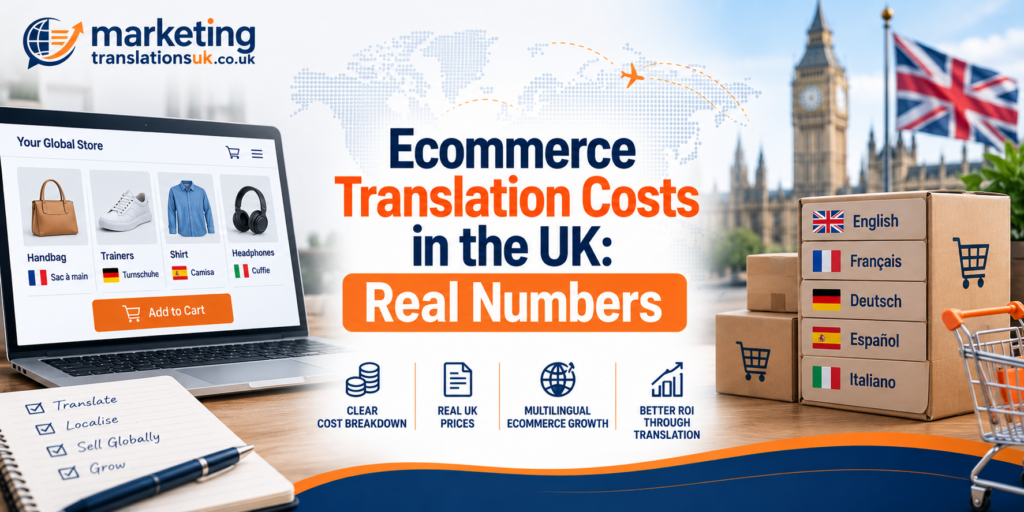
Professional ecommerce website translation in the UK typically costs between £0.10 and £0.25 per word per language, with creative pages and rare language pairs sitting at the top of that range. Most mid-sized stores spend roughly £2,000–£6,000 per language for their core site and priority products, rather than translating an entire catalogue at once. The final figure depends on word count, language pair, creativity level, turnaround and how much review you build in — not on your number of SKUs alone.
Over the years, we have quoted on hundreds of ecommerce projects, and the same conversation happens almost every time: two quotes have arrived, one is three times the other, and nobody has explained why. At Marketing Translations UK, our specialists work only on marketing content, so we price this work daily and know exactly where the gaps hide. Here is how ecommerce translation pricing in the UK actually works, so you can compare quotes properly and budget with confidence.
What Uk Ecommerce Translation Pricing Actually Looks Like
Most UK suppliers price per word, per language. Everything else — review, project management, formatting — either sits inside that rate or gets billed separately, and that single difference explains most of the spread between quotes.
General market ranges in the UK look roughly like this:
- Standard product and page translation: around £0.10–£0.14 per word. Adequate for straightforward descriptions and informational pages.
- Professional marketing translation: around £0.14–£0.18 per word. The realistic band for landing pages, category copy and anything written to persuade.
- Creative work and transcreation: £0.20 per word and upward, or priced per project. Slogans and campaign lines are rebuilt rather than converted, so they take far longer per word.
- Review or proofreading only: usually hourly, roughly £30–£50.
- Minimum project fee: commonly £50–£100, so small jobs are rarely priced purely per word.
Our own rates sit in this band and are published on the homepage pricing table, starting at €0.12 per word for standard marketing content and €0.20 for creative campaign work. We quote in euros because most of our work is into European languages; the equivalent sterling figure moves with the rate on the day.
When you are holding two quotes, one question separates them faster than any other: does this rate include a second linguist’s review? A quote without review will always look cheaper and will usually cost more later.
Estimate Your Word Count Before You Ask Anyone
You cannot budget without a word count, and most store owners overestimate theirs by an order of magnitude. Ten minutes gets you within about 15%.
Work through it in this order:
- Core pages. Homepage, about, contact, delivery, returns, FAQ, category pages and legal pages. For most stores this totals 6,000–15,000 words.
- Product pages. Multiply your average description length by the number of products you will actually translate — not by your catalogue. At 120 words per product, 200 priority products is 24,000 words, not the 360,000 a full catalogue would be.
- Transactional copy. Checkout, cart, error messages, shipping notices, confirmation emails. Small in volume, disproportionate in impact — usually 1,500–3,000 words.
- Metadata. Meta titles, descriptions and image alt text across everything you translate. Easy to forget, and quoted separately by most suppliers.
- Email and campaign flows. Welcome, abandoned cart, post-purchase. Often another 2,000–4,000 words.
A typical mid-sized store translating core pages plus 200 priority products lands around 35,000–45,000 words per language — roughly £4,000–£7,000 at professional rates.
The Seven Variables That Move Your Rate
Two quotes for the same store can differ legitimately. Knowing why lets you push back on the right things.
Language pair. German, French and Spanish are competitive markets with plenty of qualified marketing translators. Nordic languages, Japanese and Arabic cost more because fewer people do this work at that level.
Creativity required. A specification table and a hero headline are not the same job. Creative work can cost double standard translation per word, and is worth it only where persuasion decides the sale.
Subject expertise. Cosmetics, supplements, finance and technical products need translators who know the regulated terminology. Specialists charge accordingly, and the alternative is a compliance problem.
Turnaround. Express work typically adds 25–50%. Planning two weeks ahead is the cheapest discount available in this industry.
Volume and repetition. Large catalogues repeat heavily — sizing, materials, care instructions, delivery wording. Repeated segments should be discounted. A supplier who ignores repetition is overcharging you.
File format and access. Clean exports are cheap. PDFs, screenshots, hard-coded banner text and awkward CMS structures add engineering time that has nothing to do with language.
Quality level. Machine output with light editing is cheapest, human translation with a second reviewer costs more, and full creative adaptation costs most. Choosing on price alone has a predictable failure mode, set out in why machine translation fails for marketing campaigns in Europe.
Freelancer, Agency Or Machine: The Real Comparison
Cheapest per word is rarely cheapest per project. The comparison that matters is total cost including review, coordination and rework.
| Option | Typical rate | Works well for | The catch |
|---|---|---|---|
| Freelancer | £0.08–£0.14 per word | One language, small scope, ongoing relationship | You manage quality, deadlines and cover; no second reviewer; hard to scale to five markets |
| Machine plus light editing | £0.04–£0.08 per word | Long-tail products, low-traffic pages, internal content | Weak on tone, risky on legal and safety copy; errors surface later as returns |
| Specialist agency | £0.14–£0.22 per word | Multi-language rollouts, brand-critical pages, ongoing catalogues | Higher headline rate, but review, consistency and coordination are included rather than optional |
Factor in rework honestly. Retranslating a badly localised store costs the original budget again, plus the sales you lost and the returns you absorbed during the months it was live.
Three Ways To Cut The Bill Without Cutting Quality
You can usually reduce a quote by 30–40% by changing scope and reuse rather than by negotiating rates down.
Translation memory and a glossary from day one. Translation memory stores approved sentences so repeated content is charged once. Ecommerce catalogues repeat constantly, so the saving compounds with every batch. A glossary keeps terminology identical, which cuts review time as well as translation cost.
Translate by revenue, not by catalogue. Put bestsellers, hero pages, checkout and returns copy into full human translation; give mid-tier products edited machine output; leave the long tail until it earns attention. This is the single largest lever on the number, and the practical method for deciding which products belong in which group is set out in how automated product descriptions affect checkout conversions.
Phase by market. Fund one language, prove the return over 60–90 days, then reinvest. Phasing spreads the cost across quarters and stops you paying for four markets before you know whether one works.
Hidden Costs That Quotes Leave Out
The gap between a quote and a final invoice usually sits in items nobody listed. Ask about all of these before you sign:
- Second linguist review — included, or an extra line?
- Project management — often 5–10% on larger rollouts
- Metadata and alt text — frequently excluded from word counts
- Text inside images and banners — needs design work, not just translation
- In-context review on staging — the step that catches broken layouts
- Ongoing updates — new products and seasonal campaigns need a monthly allowance, not a one-off budget
- Revision rounds — check how many are included and what counts as one
If you are weighing quotes that differ wildly, the itemised breakdown to demand is in why quotes for the same brief differ by thousands.
Frequently Asked Questions About Ecommerce Translation Costs
How Much Does It Cost To Translate A Whole Online Store?
For most mid-sized UK stores, expect roughly £4,000–£7,000 per language for core pages plus around 200 priority products. Translating thousands of SKUs runs far higher, which is why translating by revenue rather than by catalogue is the standard approach.
Why Do Translation Quotes Vary So Much?
Because they often describe different work. One may include a second linguist review, project management, metadata and in-context checks; another covers raw translation only. Language pair, creativity level and turnaround shift rates legitimately on top of that. Always fix the scope before comparing the price.
Is Machine Translation With Post-Editing Worth It For Ecommerce?
For long-tail products and low-traffic pages, yes — it typically costs around half of full human translation. For homepages, campaign copy, checkout wording and anything legal or safety-related, no. Those pages carry your brand and your risk.
How Long Does Ecommerce Website Translation Take?
Most translators handle around 2,000–2,500 words per day, plus review time. A 40,000-word project in one language usually runs three to four weeks. Several languages can run in parallel, so five markets need not take five times as long.
Can I Get A Fixed Price Instead Of A Per-Word Rate?
Yes, once the scope is defined. Fixed project pricing works well when word count, languages, review level and deadlines are agreed upfront. Ongoing catalogue work is usually better on a monthly retainer, which also keeps terminology and turnaround consistent.
Should I Budget For Translation As A One-Off Or An Ongoing Cost?
Both. The initial build is a project cost; new products, seasonal campaigns and updated legal text are an ongoing one. Stores that budget only for the launch end up with a storefront that slowly reverts to English as new content is added.
Get An Honest Quote Before You Commit Your Budget
Translation pricing only looks confusing until you can see what sits inside each rate. In our experience, the stores that budget well are the ones that scope properly first — they count their words, decide which pages genuinely need a human, and refuse to compare a review-included quote with one that quietly leaves review out. Our specialists work only on marketing and ecommerce content, so you are paying for copy that sells rather than copy that merely matches.
We tell you upfront what is included, where translation memory will save you money, and which pages we would leave until later. Our process is simple: you send your content or a link to your store, we review the scope, and you get clear pricing with no hidden extras. If you are weighing up two quotes right now, send us your store details for a free, no-obligation quote and we will tell you honestly what your project should cost. We’re here to help, whether or not you order with us.