A tagline is the shortest thing you will ever sign off and the most expensive thing to get wrong. Five words carry your whole positioning, sit on packaging and media buys for years, and give you nowhere to hide when one of them means something you never intended.
Tagline translation mistakes happen because short copy has no context to protect it. A long paragraph can survive one odd word. A five-word line cannot. When it breaks, it breaks in public, on billboards, in a market where you have no way to quietly pull it back.
At Marketing Translations UK we screen brand lines before they ship, and we also spend a fair amount of time telling clients that half the famous horror stories they have read are not true. Both matter. Below are the cases with real evidence, the ones that are marketing folklore, and the checks that keep your line out of either list.
Why Do Taglines Fail In Translation More Than Any Other Copy?
Four things stack up in a way they never do in body copy.
There is no context to correct a misreading. In a landing page, a surrounding sentence tells the reader which meaning you intended. A standalone line gives them nothing, so the funniest or crudest available reading wins.
Sound matters as much as meaning. Taglines get spoken in radio and video, and a phrase can be written correctly while sounding like something else entirely in the local accent. Written checks alone miss this completely.
Slang moves faster than dictionaries. A word can be neutral in a reference book and carry a very different meaning on the street in Madrid or Mexico City. Bilingual staff who left the country ten years ago will not catch it.
Names travel with the line. Most public failures are product or brand names rather than the tagline itself, and those are far harder to change once packaging is printed.
Famous Tagline Translation Mistakes That Are Actually Documented
These are the cases with a clear record of a brand changing something as a result.
| Brand | Market | What went wrong | What the brand did |
|---|---|---|---|
| Mitsubishi Pajero | Spanish-speaking markets | The model name matches vulgar Spanish slang | Sold as the Montero in Spain and Latin America |
| Vicks | Germany | The V is pronounced as an F, producing a crude word | Marketed as Wick in German-speaking countries |
| Toyota MR2 | France | Said aloud, the name sounds like a French obscenity | The number was dropped from the French name |
| IKEA FARTFULL | English-speaking markets | A normal Swedish word reads as toilet humour in English | The product name was retired |
| HSBC “Assume Nothing” | Several markets | The line was rendered as an instruction to do nothing | A global rebrand, widely reported at around $10 million |
The pattern is worth noting. Not one of these is a grammar failure. Every one is a connotation failure, which is why proofreading never catches them.
Are Famous Translation Fails Actually True? The Ones That Are Mostly Legend
If you are building a pitch deck or an internal case for budget, be careful which examples you use. Several of the most quoted stories have no primary source and have been repeated between textbooks for decades.
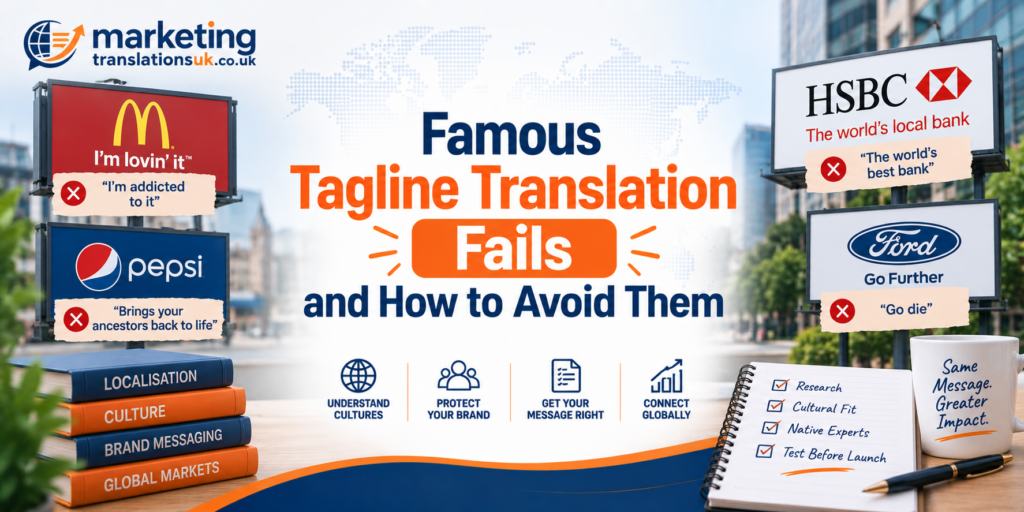
The Pepsi line said to promise Chinese customers their ancestors back from the dead has never been traced to an actual campaign. The Chevrolet Nova story, in which “no va” supposedly meant “does not go” in Spanish, is contradicted by the car’s real sales record in Latin America. The claim that KFC’s “Finger lickin’ good” became “eat your fingers off” in China is repeated everywhere and evidenced almost nowhere, and the brand went on to become one of the most successful foreign chains in the country. The Coors and Parker Pen stories sit in the same bucket.
We flag this for a practical reason. If you present an unverified story to a board and someone checks it in thirty seconds, your budget request loses credibility. Use the documented cases above instead. They make the point just as well and survive scrutiny.
What Actually Goes Wrong When A Slogan Crosses A Border
Sound-Alike Problems And Phonetic Association
Read every candidate line aloud in the target language, with a local accent, before anything else. Brand names and short lines are spoken far more than they are read, and the failures above are almost all phonetic. This check costs nothing and catches the most damaging category of error.
Meaning Problems: Idioms, Puns And Unintended Second Readings
Puns and rhyme do not survive a border. If your line rests on wordplay, it must be rebuilt around a different idea in each market rather than converted. Ask a native reviewer for every reading a phrase could carry, including the crude one, rather than asking whether the translation is correct.
Register, Taboo And Market-Specific Sensitivity
A line that reads as bold in Britain can read as arrogant in Australia, disrespectful in Japan, or non-compliant in the Gulf, where religious references and gender portrayal carry rules UK copy never has to consider. Our specialists treat this as a separate check, not part of proofreading.
How Do Brands Check A Tagline Before Launching Abroad?
This is the linguistic risk assessment we run, and it works whether you have one target market or twelve.
- Shortlist three candidate lines, not one. Screening a single line forces a yes or no decision late in the process. Three gives you somewhere to move when one fails in a single market.
- Screen every candidate across all target markets at once. Each line is checked by native reviewers in every country simultaneously, so you learn early that a favourite works in five markets and fails in the sixth, rather than discovering it after approval.
- Run the spoken test and the slang test separately. One reviewer reads it aloud and reports what it sounds like. Another checks current slang and regional connotation, ideally someone living in the market now, not a diaspora speaker.
- Check trademark and domain availability in parallel. A line can be linguistically perfect and legally unavailable. Running this alongside the language check saves a full round of rework.
- Rebuild rather than translate the survivors. For each approved market, our specialists produce two or three routes with an English rationale, so you can compare intent rather than words and choose without speaking the language.
- Test the finalists with a small local audience. Even a handful of in-market readers will tell you whether a line feels like a brand talking or a person speaking, which no amount of desk checking reveals.
- Lock the approved wording in writing. Once signed off, the line goes into a locked-terms list so no regional office edits it later and quietly creates a second version of your brand.
Pre-Launch Tagline Checklist For International Rollout
- ✔ Every candidate read aloud by a native speaker in each target market
- ✔ Current slang and street usage checked in-market, not from a dictionary
- ✔ All second meanings listed, including the offensive ones
- ✔ Religious, political and cultural sensitivities reviewed per region
- ✔ Trademark and domain checked in every launch country
- ✔ Character and line length tested in the actual layout, including longer languages
- ✔ Claim checked against local advertising rules, since the ASA, FTC and ACCC all differ
- ✔ Approved wording recorded and locked before any asset is produced
How Much Does A Mistranslated Campaign Cost?
The invoice is the smallest part. A recalled line means reprinting packaging, rebuilding assets, buying media again, and explaining the delay internally. Where the name reaches products, it can mean a supply chain change.
Then there is the part nobody budgets for. A tagline earns recall over years, and a withdrawn line resets that to zero in that market while your competitor keeps building. Screening a shortlist before launch is a small, fixed cost against an open-ended one, which is why brands that have been through it once never skip it again.
Frequently Asked Questions About Slogan Translation Mistakes
Can You Translate A Slogan Word For Word?
Almost never. Word-for-word conversion preserves the vocabulary and loses the rhythm, the wordplay and often the meaning. Short persuasive lines need rebuilding around the same idea, which is why they are quoted per project rather than per word.
Should We Keep Our English Tagline In Foreign Markets?
Sometimes, and it is a legitimate choice for fashion, tech and luxury brands where English signals a global identity. It only works if the line is short, easy to pronounce locally and carries no awkward sound-alike, so it still needs screening before you decide to keep it.
How Do You Test A Tagline In Another Language?
Native reviewers read it aloud, list every possible meaning, check current slang, and then a small in-market group reacts to it in context. Desk review alone catches spelling problems and misses the connotation problems that actually cause failures.
How Long Does Slogan Transcreation Take?
Screening a shortlist across several markets usually takes a few working days. Building and testing new routes for each market takes longer, so we ask for the brief before creative production starts rather than after the artwork is signed off.
How Do You Avoid Offensive Brand Names In Other Languages?
Screen the name in every launch market before it is registered, not after. Include phonetic checks, regional slang, and abbreviations the name could be shortened to, since consumers shorten names in ways brands never plan for.
Can Ai Tools Screen A Tagline For Offensive Meanings?
No. These tools work from general text and cannot judge current slang, regional taboo or how a phrase sounds spoken in a local accent. We do not use them at any stage of client work.
Final Thoughts
Every documented failure on this page shares one trait: the language was correct and the meaning was not. That gap is invisible to spellcheck, to bilingual colleagues being polite, and to any process that asks “is this accurate?” instead of “what else could this possibly mean?”
Screening a shortlist takes days. Recalling a live campaign takes quarters. If you have a line waiting for sign-off, send it to us with your target markets and our specialists will tell you plainly what it says, what it sounds like, and what it could be mistaken for.