You launched in the States and Australia without touching a word of copy. Why would you? It is already English. Then the US bounce rate climbed, Australian ads got clicks but no sign-ups, and nobody could point at a single thing that was wrong.
UK brand voice adaptation is the work that fixes this. It rewrites tone, phrasing, spelling, calls to action and price presentation for each English-speaking market, while keeping your brand recognisably yours. It is not translation. It is the layer most UK brands skip because the language looks identical on the surface.
At Marketing Translations UK we adapt campaigns between English markets as often as we work across languages. Below is exactly what changes for the US and Australia, what to leave alone, and how to run it without three separate brands appearing by accident.
Why “It Is Already In English” Costs Uk Brands Sales In The Us And Australia
Shared vocabulary hides three different sets of expectations.
American readers expect the benefit first. British copy tends to build a small amount of context before it commits, and by the time it does, a US reader has scrolled. Understatement reads as hedging. “Quite good” is high praise in Britain and lukewarm in America, and that gap sits inside almost every British value proposition.
Australian readers expect the opposite of hype. Big claims and hard urgency get treated as sales talk, and confidence has to arrive without self-importance. British copy is often closer to Australian taste than American, so brands assume Australia needs no work and get caught out by vocabulary, GST-inclusive pricing and a much more casual register.
The damage never shows as one broken page. It shows as a slow drift in conversion, and as support questions about words your UK customers never had to ask about.
Uk Vs Us Vs Australian Tone Of Voice: What Actually Changes
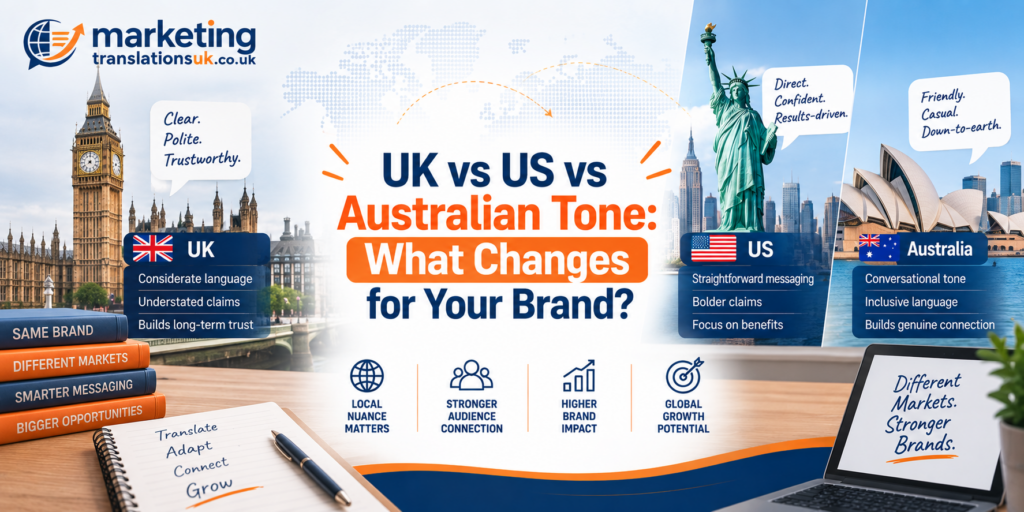
Our specialists work to a fixed set of dimensions when adapting between English markets. This is the short version.
| Dimension | United Kingdom | United States | Australia |
|---|---|---|---|
| Opening move | Context, then claim | Claim, then proof | Claim, stated plainly, no build-up |
| Humour | Irony and understatement | Warm, obvious, rarely self-deprecating | Dry, direct, self-deprecating is welcome |
| Superlatives | Used sparingly | Expected and accepted | Treated with suspicion |
| Calls to action | Polite and indirect | Imperative and urgent | Short, plain, no pressure |
| Formality | Mid, brand-dependent | Friendly, first-name | Informal by default |
| Proof style | Credentials and heritage | Numbers, reviews, results | Practical detail, no boasting |
Two dimensions cause the most rework. Calls to action come first: “Find out more” is normal in Britain, soft in America, and fine in Australia. Superlatives come second, because a line that builds trust in the US quietly reduces it in Australia.
Common British Phrases That Confuse Us Customers
These appear in real UK marketing files every week.
Words That Change Meaning Or Stop Working In The Us
Pants means underwear in Britain and trousers in America, which makes apparel copy embarrassing fast. Whilst, amongst and shall read as formal and dated. Bespoke and kitted out often need replacing with custom and equipped. Table an item means to raise it in Britain and to postpone it in America, which matters in B2B copy. Sorted, chuffed, cheeky and fortnight simply do not carry.
Ecommerce vocabulary is a separate list: basket becomes cart, delivery becomes shipping, postcode becomes zip code, VAT becomes sales tax, and mobile becomes cell. Leaving these unchanged makes a checkout feel foreign at the moment trust matters most.
Words And Habits That Land Badly In Australia
Australian English keeps most British spellings, so the trap is tone rather than vocabulary. Corporate throat-clearing and status language are the main problems: phrases like “market-leading”, “world-class” and “trusted by industry leaders” read as bragging.
There is still a vocabulary layer. Australia uses program, not programme, in almost every context, and thongs means footwear, not underwear. Postcodes exist, but the address form needs a state field, and phone formats differ from both the UK and US.
Spelling, Dates, Currency And Units You Must Change First
These are mechanical, cheap to fix, and the fastest credibility win available.
- Spelling: organise and colour stay in Australia and become organize and color in the US. Licence and practice change form as nouns and verbs in Britain and Australia, but not in America.
- Dates: DD/MM/YYYY works in the UK and Australia, MM/DD/YYYY is required for the US. Where a date carries a deadline, write the month as a word and remove the risk entirely.
- Currency: show £, US$ and A$ distinctly. A bare dollar sign on an Australian page will be read as Australian dollars, which is fine, but the same symbol on a shared page is not.
- Pricing display: Australian consumer rules require the single total price shown to include GST. US prices are usually shown before sales tax, since tax varies by state.
- Units: the UK mixes metric and imperial, Australia is metric, the US is imperial. Give sizes, weights and shipping dimensions in the local unit rather than a converted figure in brackets.
How To Adapt Your Uk Brand Voice Step By Step
- Lock the parts of your voice that must never move. Our specialists first agree what is fixed: product names, taglines, brand values and regulated wording. Everything else becomes adjustable. Without this list, market versions drift apart within two campaigns.
- Write regional layers, not new style guides. Keep one master tone of voice document and add a short US layer and Australian layer underneath it, each covering register, CTA style, spelling, formats and banned words. Three separate guides produce three separate brands.
- Rank your assets by persuasion load. Homepage headlines, ad copy, CTAs, checkout and email subject lines get full rewriting. Specifications, help articles and policy pages usually need only spelling and format changes. This split is what keeps the budget sensible.
- Rebuild the calls to action first. CTA wording moves conversion faster than any other change, and it is the shortest text to test. Adapt it, then measure, before committing to a full site rewrite.
- Have a local reader mark it up, not just approve it. An in-country reviewer in each market should flag anything that sounds imported, then explain why. Approval alone teaches you nothing; the reasons feed straight back into the regional layer.
- Match the SEO and the technical setup to the copy. Adapted pages need their own keyword research and correct hreflang tags, or the work stays invisible.
Does English Localisation Help Seo In The Us And Australia?
Yes, and this is the part most brands underestimate.
Search behaviour differs even where the language does not. Americans search for sneakers, Britons for trainers, and Australians for both depending on the category. If your US pages keep British terms, they compete for searches nobody is running.
There is also a duplicate content risk. Near-identical en-GB, en-US and en-AU pages leave search engines guessing which to show. Correct hreflang tags on every regional version solve it, and adapted copy makes each version genuinely distinct rather than a spelling variant.
Our specialists run local keyword research per market before rewriting, so the adapted page is built around terms buyers actually type instead of translated assumptions.
Advertising Rules Change Even When The Language Does Not
A claim cleared for the UK is not automatically safe elsewhere. British advertising is governed by the ASA and the CAP Code, the United States by the FTC, and Australia by the AANA codes with consumer law enforced by the ACCC.
The practical differences show up in three places: comparative claims, testimonials and influencer disclosure, and how prices and discounts must be presented. Australia’s total-price rule — which requires the full price, including GST, shown as clearly as any partial figure — and the US requirement for clear paid-partnership disclosure catch UK brands most often. Where a claim is central to your campaign, confirm it against current guidance in that market before launch rather than after.
Frequently Asked Questions About Uk Brand Voice Adaptation
Do I Need To Localise English Content For The Us Market?
Yes, if the content is meant to persuade. Homepage copy, ads, CTAs, emails and checkout wording all benefit, because American readers expect the benefit stated up front and use different everyday vocabulary. Technical documentation usually needs only spelling and format changes.
Is Australian English The Same As British English?
Not in practice. Australian spelling follows British convention in most cases, but vocabulary, register and pricing rules differ, and Australian audiences respond badly to promotional language that British audiences tolerate. Copying UK copy across unchanged is the most common mistake we correct.
Do I Need Separate Websites For The Us And Australia?
Usually separate regional versions rather than separate sites, whether that is subfolders or country domains. What matters is that each version has adapted copy, local pricing and correct hreflang tags, so search engines serve the right page to the right country.
How Much Does English To English Localisation Cost?
It is quoted per project rather than per word, because the work is editing and rewriting judgement rather than volume. Adapting a set of key pages and ad assets costs far less than a full translation project, which is why we often recommend starting there.
How Long Does Brand Voice Adaptation Take?
A focused set of assets for one market usually takes a few working days including in-country review. Building the regional layers for both markets takes longer at the start, then every later campaign moves quickly because the rules already exist.
Can I Use Ai Tools To Convert British English To American English?
They will change spellings and miss everything that matters. Tone, CTA strength, humour, claim safety and local search terms all need human judgement, and we do not use these tools on client work at any stage.
Final Thoughts
Sharing a language is not the same as sharing an audience. The US wants the point first, Australia wants it without the polish, and Britain sits between them, which is exactly why UK copy underperforms in both directions at once.
The fix is smaller than most brands expect. Adapt the assets that carry the persuasion, set the regional rules once, and leave the rest alone. Send us your live US or Australian pages and our specialists will tell you honestly which lines are costing you conversions and which are working fine as they are.